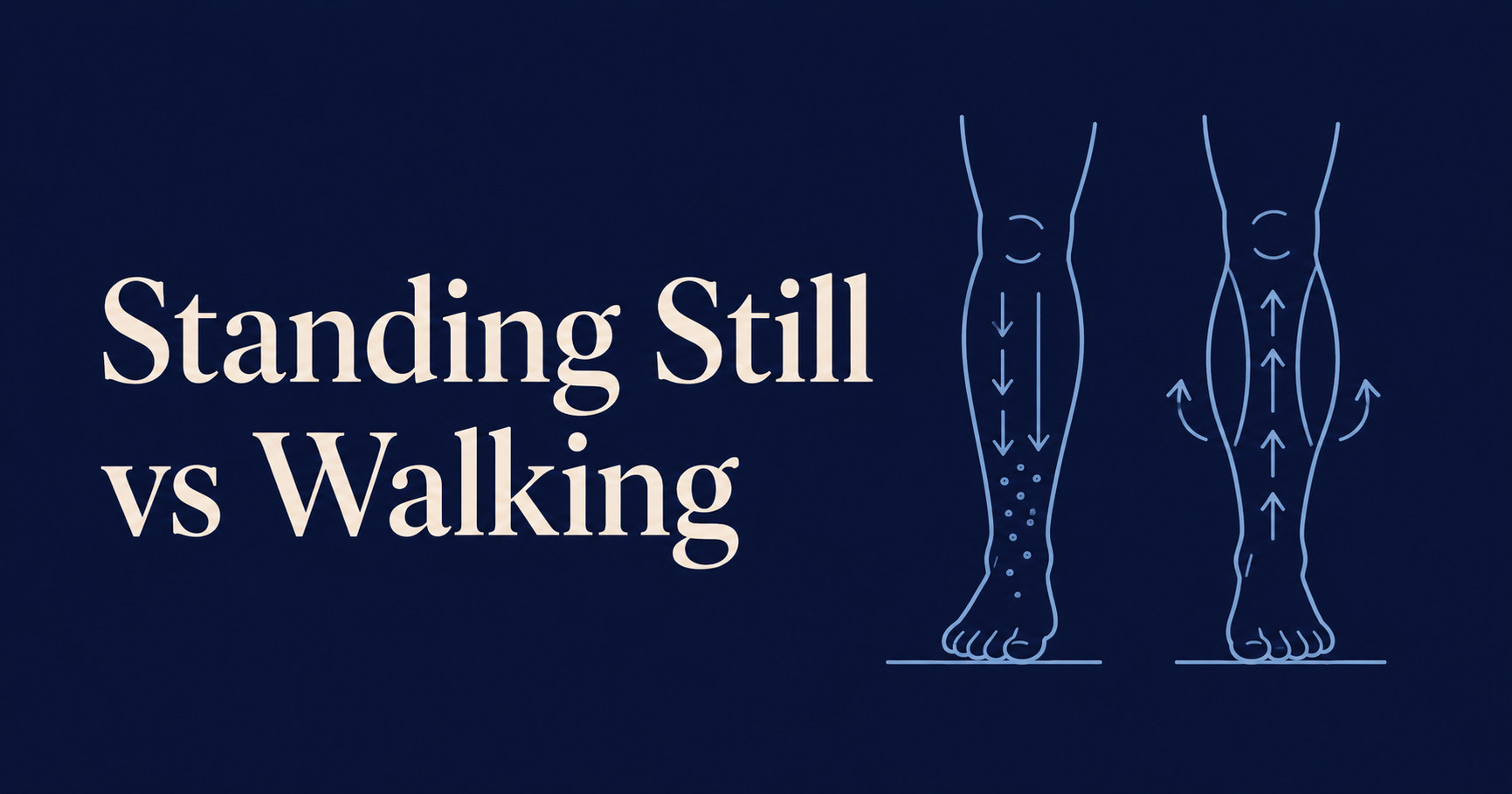
This one confused me for a long time because it seems backwards. You would think that moving around would be harder on your body than just standing still. Walking requires energy. Standing still requires nothing, right?
Wrong. Standing still with POTS is one of the most physiologically demanding things you can do. A grocery store line, a concert, waiting at a bus stop, standing in the kitchen cooking a meal. These are the situations that would bring me to my knees, sometimes literally, while I could often manage a slow walk for longer than I could manage standing in one place for two minutes.
Once I understood why, it made complete sense.
Your muscles are a pumping system
Here is the piece of the puzzle most people are never told. Your heart is not the only thing responsible for moving blood around your body. Your muscles, particularly the large muscles in your legs and calves, act as a secondary pump. Every time they contract and release, they physically squeeze blood upward through your veins, working against gravity to push it back toward your heart and from there to your brain.
This is called the skeletal muscle pump, and it is a critical part of how your circulatory system manages blood flow when you are upright. It is not a backup system. It is an essential part of normal circulation.
When you walk, your leg muscles are contracting constantly. Every step activates your calves, your thighs, your glutes. That continuous muscular contraction is continuously pumping blood upward, fighting the pooling that gravity causes, and helping your heart maintain circulation to your brain.
When you stand still, that pump stops. Completely.
What happens when the muscle pump switches off
The moment you stop moving and stand in one place, blood begins to pool in your lower legs and feet with nothing actively pushing it back up. Your veins, which are lower pressure and more elastic than arteries, stretch to accommodate the accumulating volume. Your blood pressure at the level of your brain starts to drop.
In a healthy autonomic nervous system, this triggers an immediate compensatory response. Blood vessels constrict to push blood upward. Heart rate increases slightly. The system catches up quickly and you stay stable.
In POTS, that compensation is unreliable and insufficient. Blood keeps pooling. Your heart rate spikes dramatically trying to compensate. And without the muscle pump helping, it is fighting a losing battle. The longer you stand still, the more blood pools, the harder your heart works, and the worse you feel.
This is why symptoms with POTS tend to get progressively worse the longer you stand in one place. It is not that you hit a wall suddenly. It is that the pooling accumulates continuously with nothing countering it, and your compensatory mechanisms eventually cannot keep up.
Why walking feels like relief
When you start walking after standing still, you are essentially switching the muscle pump back on. Your calves start contracting. Blood gets pushed back up. Your heart gets better return volume and does not have to work as frantically. The circulation to your brain improves. Symptoms often ease noticeably within a few steps.
This is also why fidgeting, shifting your weight, crossing your legs, or doing small calf raises while standing helps. Any muscular contraction in your legs, even small ones, activates some version of the muscle pump and counteracts pooling. It looks like restlessness to an outside observer. It is actually your body instinctively trying to solve a circulatory problem.
Why certain environments are so specifically brutal
Grocery store lines. Museum visits. Standing at a party. Cooking at the stove. Waiting rooms. These all have something in common: prolonged static standing with no opportunity to move continuously. For someone with POTS they are not just uncomfortable. They are physiologically destabilizing in a way that is hard to explain to someone who has never experienced it.
The heat that often accompanies these environments makes it worse. Warmth causes blood vessels to dilate further, which means even more pooling. Crowded spaces with poor air circulation compound the problem. And the stress of trying to appear normal while your body is in crisis keeps your sympathetic nervous system activated on top of everything else.
What actually helps in these situations
Moving whenever possible is the most effective strategy. Even small movements matter. Walking in place, shifting weight from foot to foot, doing subtle calf raises. Anything that keeps the muscle pump partially active.
Compression garments reduce the amount of blood that can pool in your lower legs by physically limiting how much the veins can expand. They do not replace the muscle pump but they reduce the burden on it.
Salt and fluid loading before situations where you know you will be standing helps by increasing your blood volume so there is more to go around even when some pools.
Leaning against a wall or counter when possible gives your muscles partial support and reduces the total effort required to stay upright.
And over time, as your cardiovascular conditioning improves, your body gets better at the compensatory responses that static standing demands. Your blood vessels get quicker at constricting. Your heart becomes more efficient. The standing still problem does not disappear overnight but it does improve as your overall capacity builds.
You were not being dramatic about the grocery store line. Your circulatory system was genuinely failing to keep up with what static standing was asking of it. Now you know exactly why.