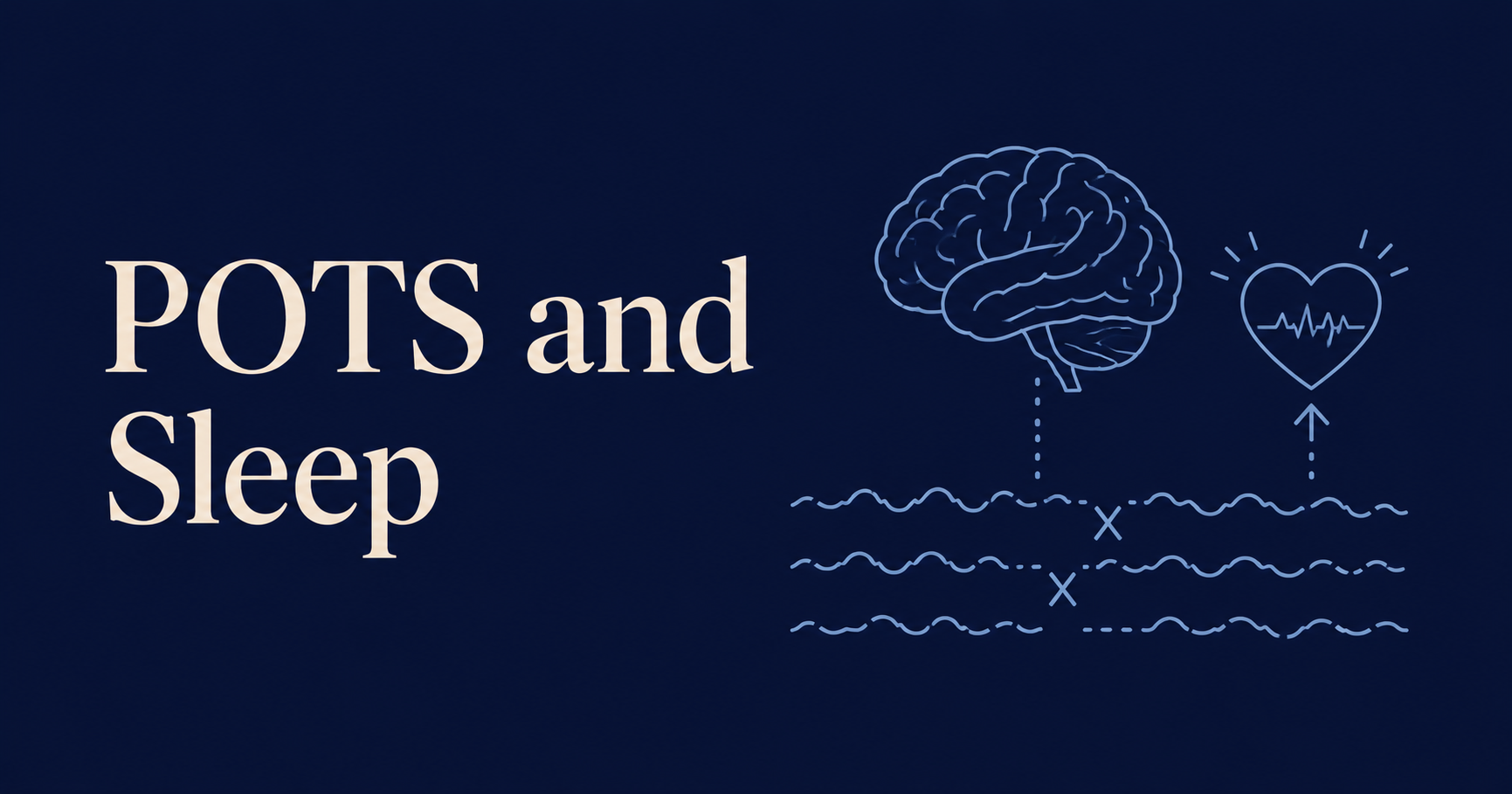
I used to think I just needed more sleep. I would go to bed early, sleep eight or nine hours, and wake up feeling like I had not slept at all. Heavy, foggy, unrefreshed, already exhausted before the day had even started. For a long time I assumed I had some separate sleep disorder on top of everything else. I tried sleep hygiene tips, melatonin, blackout curtains, all of it.
What I did not understand was that the problem was not how much I was sleeping. It was what my nervous system was doing while I was sleeping.
What restorative sleep actually requires
To understand why POTS disrupts sleep quality, you need to understand what your body is supposed to do during the night. Deep restorative sleep, particularly the slow wave and REM stages, requires your nervous system to shift into a parasympathetic dominant state. Parasympathetic is the rest and digest branch, the opposite of fight or flight. Your heart rate drops. Your blood pressure eases. Your muscles relax. Your body uses this window to repair tissue, consolidate memory, regulate hormones, and essentially do all the maintenance that keeps you functional.
This shift into parasympathetic dominance requires your autonomic nervous system to hand over control smoothly and stay there for extended periods throughout the night. In POTS, that handover is compromised.
Why your sympathetic nervous system will not switch off
In POTS the sympathetic nervous system, the branch responsible for alertness and stress responses, tends to run at an elevated baseline. During the day this shows up as a racing heart, high adrenaline, anxiety, and hypervigilance. At night it does not just turn off because you closed your eyes.
Many people with POTS have elevated norepinephrine levels, a stress hormone that keeps the sympathetic system activated. That elevation does not reliably drop at bedtime. Your brain and body stay in a state of low level alertness throughout the night, preventing you from sinking into the deep restorative stages of sleep that actually make you feel rested.
Even when you do fall asleep, your body may keep partially waking itself up. Research into dysautonomia and sleep consistently shows disrupted sleep architecture in people with POTS, meaning less time in deep sleep, more frequent micro-arousals, and an overall pattern that looks more like light dozing than genuine restoration.
The heart rate problem during sleep
Another piece of this is that POTS does not fully resolve overnight. While lying down does reduce the orthostatic challenge and typically brings heart rate down compared to standing, heart rate in POTS during sleep is often still higher than it should be. An elevated resting heart rate means your cardiovascular system is still working harder than normal even at rest.
Your body interprets sustained elevated heart rate as a sign that something requires attention. It does not fully commit to deep rest when it believes it might need to mobilize. So even physiologically, a higher than normal sleeping heart rate keeps your system hovering in a lighter, more alert state rather than dropping into deep recovery.
Why you might feel worse right after waking up
The transition from lying down to upright in the morning is one of the biggest orthostatic challenges of the day. Your blood volume has been in a horizontal position all night. Your heart and vessels have been in whatever version of rest your autonomic system could manage. The moment you sit up or stand, your blood pools into your lower body, your heart rate spikes, and your already under-rested system has to immediately start compensating.
This is why morning is often the hardest time of day for people with POTS. You have not had genuine restoration overnight, and the first thing you ask your body to do is manage one of its biggest physiological challenges. The exhaustion and brain fog that hits immediately on waking is not grogginess. It is your system already struggling before the day has begun.
What actually helps
Elevating the head of your bed slightly, around ten to twenty degrees, is one of the most evidence-supported strategies for POTS sleep. It sounds counterintuitive because lying flat seems easier, but sleeping completely flat can cause a fluid shift overnight that actually worsens orthostatic symptoms in the morning. A slight incline keeps your body in a position that more gradually transitions toward upright and reduces that dramatic morning blood pooling.
Salt and fluids in the evening, not so close to bed that they disrupt sleep, help maintain blood volume overnight. Going to bed mildly dehydrated makes the overnight cardiovascular challenge worse.
Avoiding large meals close to bedtime reduces the postprandial blood flow demand that would otherwise compete with your system trying to shift into rest mode.
Gentle reconditioning over time is the most meaningful long term change. As your autonomic regulation improves, your baseline sympathetic tone comes down. Your resting heart rate decreases. Your system becomes more capable of actually handing over to parasympathetic dominance at night. The sleep quality tends to improve as a downstream effect of the nervous system becoming less dysregulated overall.
The exhaustion you feel in the morning is real and it is earned. Your body worked hard all night just to keep its basic systems running. That is not weakness. It is what happens when your nervous system cannot fully rest. And it does get better as the system underneath it starts to stabilize.