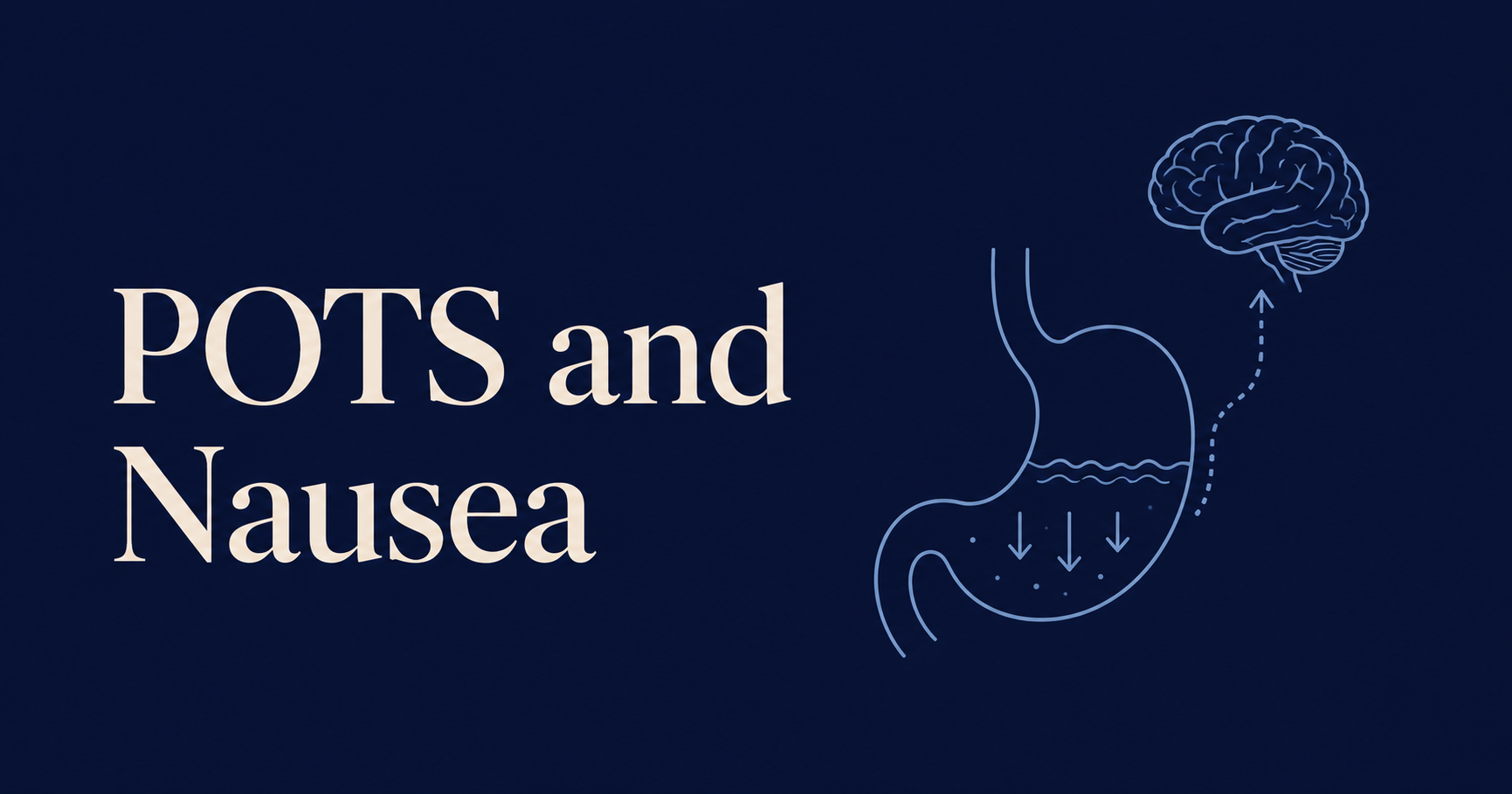
Nausea was one of the symptoms I could never fully explain to people. A racing heart, dizziness, feeling faint when you stand up, those are at least things people can picture. But nausea? It seemed random. It would show up in the morning, after meals, during flares, sometimes just because I had been upright too long. For a while I genuinely wondered if something was wrong with my stomach specifically, separate from everything else.
It is not separate. The nausea is coming from the same place everything else is coming from. And once I understood why, it stopped feeling so random and started feeling like information.
What your autonomic nervous system actually controls
Your autonomic nervous system runs everything in your body that happens without you thinking about it. Your heart rate, your blood pressure, your breathing rate, and critically, your digestion. Every single stage of digestion, from the moment food enters your stomach to the moment it moves into your intestines, is coordinated by autonomic signals.
In POTS, that autonomic system is dysregulated. The signals are misfiring or mistimed. And because your gut is completely dependent on those signals to function properly, your digestion takes a hit along with everything else.
The blood flow problem that starts it all
Here is the core of what is happening. When you stand up, gravity pulls blood down into your legs and lower body. A healthy autonomic nervous system immediately compensates by tightening blood vessels, increasing heart rate slightly, and redirecting blood back up to your brain and vital organs.
In POTS, that compensation is faulty. Blood pools in the lower body and your heart rate spikes trying to make up the difference. Your brain does not get the blood flow it needs. And neither does your gut.
Your digestive system is one of the most blood-hungry systems in your body. It needs significant circulation to move food through, produce digestive enzymes, and coordinate the muscular contractions that keep everything flowing in the right direction. When blood pools away from your core and your body is in a low-flow state, your gut essentially slows down or stalls. That slowdown is called gastroparesis when it is severe, but even a mild version of it produces nausea, bloating, fullness, and discomfort.
Why the vagus nerve makes things worse
The vagus nerve is the main communication highway between your brain and your digestive system. It is also deeply involved in regulating heart rate and blood pressure. In POTS, the vagus nerve is often not functioning optimally. It can become either underactive or erratically active, which throws off the coordination of digestion.
When vagal tone is low or dysregulated, your stomach does not get the right signals to contract properly. Food sits longer than it should. Acid production can become irregular. The muscles that are supposed to move everything through the digestive tract lose their rhythm. All of that produces nausea.
There is also a feedback loop here that makes it worse. Your gut has more nerve endings than almost any other organ. When it is distressed, it sends urgent signals back up to the brain. Those signals get interpreted as nausea, and sometimes as the urge to vomit, because your body is essentially trying to protect you from something it perceives as a threat. It does not know the threat is dysautonomia rather than bad food. It just knows things are not right and it escalates accordingly.
Why nausea is often worst in the morning
A lot of people with POTS find that nausea hits hardest first thing in the morning, before eating anything, which seems counterintuitive. If nausea were purely about digestion, you would expect it after meals. But morning nausea in POTS often has more to do with the transition from lying down to upright.
When you wake up and start moving toward vertical, your blood volume has to redistribute. Your body has been horizontal all night, which is actually a relatively comfortable state for POTS because gravity is not fighting you. The moment you sit up or stand, the whole orthostatic challenge begins again. If your body handles that transition poorly, the resulting drop in cerebral blood flow and spike in heart rate can trigger nausea before you have even had a chance to eat anything.
This is also why some people feel better if they eat something small before getting fully upright, or why lying back down can settle the nausea quickly. It is positional, not just digestive.
Why eating can make it worse
After a meal, your body naturally diverts significant blood flow to your digestive system to handle the work of processing food. This is a normal process called postprandial blood flow. In people without POTS, the rest of the circulatory system compensates without much trouble.
In POTS, that compensation is already compromised. Diverting extra blood to your gut after eating means even less available for your brain and the rest of your body. This can trigger or worsen orthostatic symptoms, including nausea, dizziness, and fatigue, in the hour or two after a meal. It is why so many people with POTS find that eating a large meal leaves them flattened on the couch, and why smaller more frequent meals tend to feel more manageable.
What actually helps
Understanding the mechanism points you toward solutions. Staying hydrated and getting enough salt helps increase blood volume, which means there is more to go around even when some pools in your legs. Eating smaller meals reduces the demand on your circulatory system after eating. Staying reclined or semi-reclined after meals gives your body a better chance of maintaining gut blood flow. Compression garments reduce pooling and support circulation more broadly, which has a downstream effect on digestion.
And reconditioning helps, too. As your cardiovascular system gets stronger and your body gets better at managing blood pressure and flow, the whole pattern starts to improve. The nausea does not disappear overnight, but it does become less frequent and less severe as your autonomic regulation improves.
Nausea with POTS is not a mystery and it is not a separate problem. It is your nervous system and your circulatory system talking to each other in a language that produces a very unpleasant symptom. Once you know what it is actually saying, you can start responding to it in ways that actually work.