I remember wanting a number so badly. Just tell me how long. Give me a date to aim for, a finish line to visualize, something to hold onto when the days were hard. I asked my doctors. I searched forums. I read everything I could find.
Nobody could give me a clean answer, and at the time that felt cruel. Looking back, the reason nobody could give me one is that there genuinely is not a single answer. But there are patterns. And understanding those patterns is a lot more useful than a number would have been anyway.
Why there is no universal timeline
POTS is not one thing with one cause and one recovery trajectory. It is a syndrome, meaning it is defined by a cluster of symptoms rather than a single underlying mechanism. Two people can both have POTS and have arrived there through completely different paths, which means their recovery paths will also look different.
Someone whose POTS developed after a viral illness and who has no complicating factors may see significant improvement within six to twelve months of consistent reconditioning. Someone who has had unmanaged POTS for five years with significant deconditioning, or who has connective tissue involvement, or who developed POTS after a prolonged period of bed rest, is working with a different starting point and a different timeline.
The variables that matter most are how long symptoms have been present, how deconditioned the cardiovascular system is, whether there are overlapping conditions like hypermobile EDS or mast cell activation syndrome, how consistently reconditioning can be maintained, and whether the original trigger has resolved.
None of those are fixed. All of them are relevant.
What the early phase actually looks like
The first one to three months of reconditioning are usually the hardest and the most discouraging. Your body is being asked to do things it has been struggling with, and the initial response is often to feel worse before you feel better. Heart rate spikes. Fatigue increases temporarily. Symptoms flare after sessions.
This phase is where most people stop. They interpret the worsening as evidence that exercise is wrong for them or that their POTS is too severe to respond. In most cases that is not what is happening. What is happening is adaptation, and adaptation is uncomfortable before it becomes improvement.
The early phase is also where progress is hardest to see because it is happening at a cellular and cardiovascular level before it shows up as symptom reduction. Your heart is getting slightly more efficient. Your blood volume is slowly increasing. Your vessels are beginning to respond more reliably. None of that is visible yet. You just feel tired and frustrated and wonder if anything is working.
It is working. It is just working underneath the surface.
When things start to shift
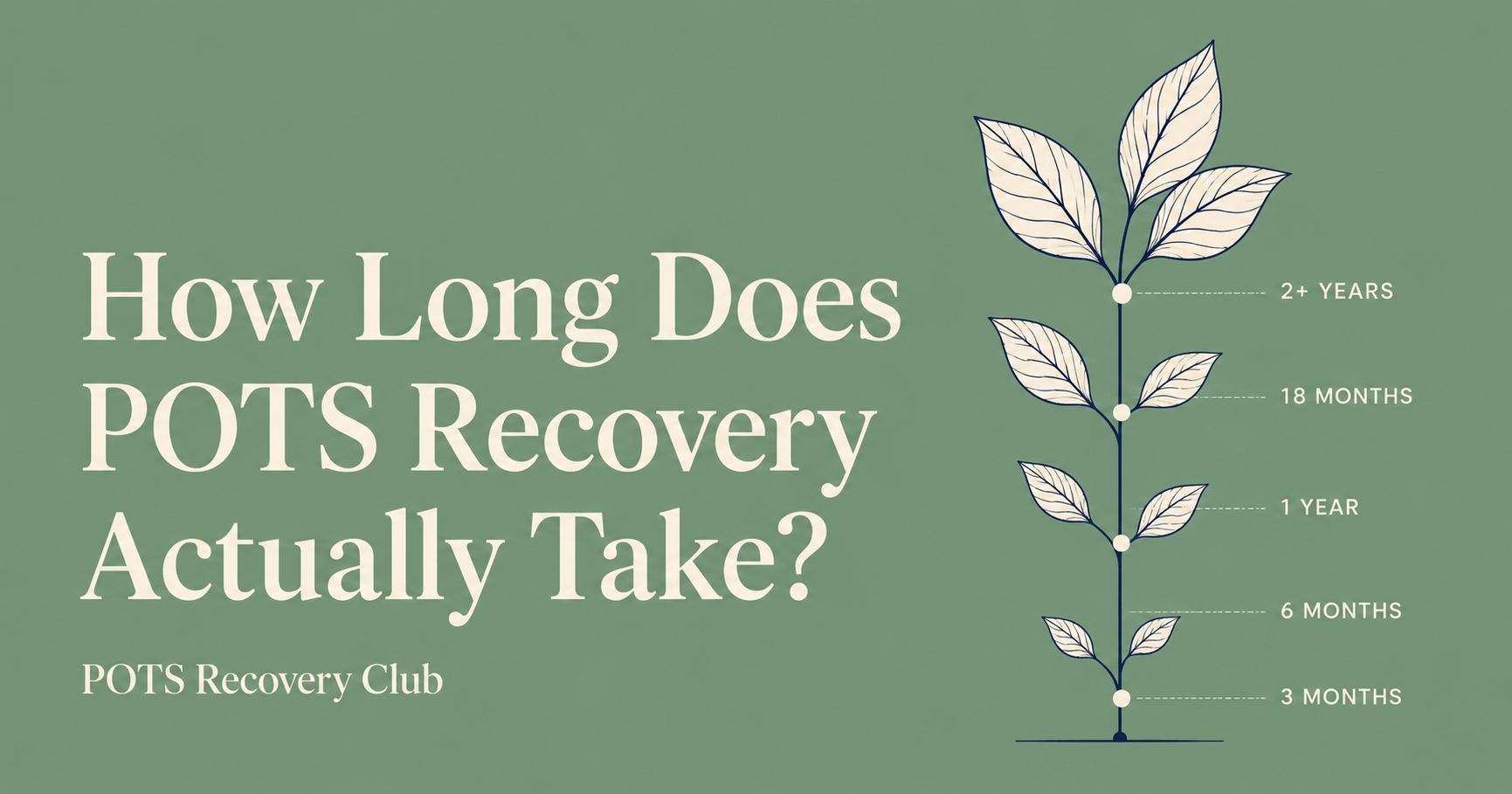
For most people who stick with consistent reconditioning, a noticeable shift tends to happen somewhere between three and six months. It rarely arrives as a dramatic turning point. It is more subtle than that. You realize you stood in the kitchen for twenty minutes without needing to sit down. You walked further than you expected and did not crash afterward. Your heart rate after a session comes back down faster than it used to.
The peaks of the worst symptoms start to reduce first. The floor of your baseline starts to lift second. The expansion of what you can do comes third. It layers in that order for most people and the layers overlap rather than arriving in clean sequential stages.
The middle stretch and why it tests you
Months six through twelve, or longer depending on your starting point, are what I think of as the endurance phase. You are better than you were. You are not where you want to be. Progress has slowed down from those early gains and it can feel like you have plateaued even when you have not.
This phase requires a different kind of commitment than the beginning did. At the beginning you were motivated by desperation and hope. In the middle stretch you have to find motivation in smaller evidence. The fact that you can do things now that you could not do six months ago. The fact that your bad days are not as bad as your old bad days were. The fact that your system is continuing to adapt even when it does not feel dramatic.
Consistency here matters more than intensity. Showing up at a level your body can handle, repeatedly, over time, is what drives continued adaptation. Big efforts followed by crashes and recovery periods do not accumulate the same way steady manageable consistency does.
What recovery actually feels like from the inside
Nobody wakes up one morning and feels recovered. It is not that kind of experience. Recovery from POTS is something you tend to notice looking backward more than forward. You look back at where you were six months ago and realize you are doing things now that would have been impossible then. The contrast becomes visible in retrospect.
Some people have a clear moment where they realize they have crossed a threshold. They run for the first time. They get through a full workday without needing to lie down. They travel somewhere and manage it without a multi-day crash. These moments matter and they are worth marking when they happen.
But the recovery itself is happening in every small session, every consistent day, every time you show up for your body even when it is hard.
The honest answer to how long
For many people with POTS who engage consistently in reconditioning, meaningful quality of life improvement happens within six to eighteen months. Full resolution, where it occurs, often takes longer. Some people are managing their condition long term rather than reaching a point of full resolution, and they are still living full lives.
The timeline is less important than the direction. If you are moving toward more capacity, more function, more good days relative to bad ones, you are recovering. Even when it does not feel like it yet.