This was the question I typed into Google more times than I can count during the worst of it. Usually late at night. Usually after a day that had beaten me down in some specific way. I needed someone to tell me it was going to be okay, and I needed them to mean it, not just say it.
So let me tell you what I actually know, from my own experience and from watching hundreds of people move through this condition in the community I have built around it.
Yes. Recovery is possible. Not for everyone in the same way or on the same timeline. But the picture is significantly more hopeful than most people are told when they first get diagnosed.
What recovery actually means
First it helps to be clear about what we mean by recovery, because it means different things to different people and the definition matters.
For some people recovery means complete resolution of symptoms. Their heart rate normalizes, they can stand without issue, they return to full activity with no ongoing limitations. This happens, especially in people whose POTS developed after a specific trigger like a viral illness, pregnancy, or a period of prolonged bed rest.
For others recovery means significant improvement. They still have a nervous system that requires some management, but they are working, exercising, living full lives, and their symptoms are mild enough that POTS is no longer the defining fact of their existence. This is probably the most common version of what recovery looks like.
For others still recovery means learning to manage the condition so well that the quality of life impact is minimal even if the underlying autonomic dysregulation has not fully resolved.
All of these count. None of them are settling. They are all real versions of getting your life back.
What actually drives recovery
The most important thing to understand about POTS recovery is that it is not passive. It does not happen by waiting it out, avoiding triggers, and resting. For most people the path toward meaningful improvement runs directly through reconditioning.
Here is why. One of the central problems in POTS is that the cardiovascular system has lost conditioning. Whether that happened because of a virus, a period of illness and bed rest, a growth spurt, or something else entirely, the result is a cardiovascular system that is not strong enough to maintain adequate circulation when upright. Blood pools. The heart compensates by racing. The autonomic system gets stuck in a dysregulated pattern.
Reconditioning works by gradually rebuilding that cardiovascular capacity. You start from wherever you are, even if that is lying on the floor doing leg raises, and you progressively challenge your system in a way it can adapt to. Over time your heart gets stronger and more efficient. Your blood vessels get better at responding to positional changes. Your blood volume increases. Your nervous system starts to regulate more reliably because it is not constantly in crisis mode.
It is slow. It is uncomfortable at first. And it is the most effective thing most people can do for long term improvement.
Why so many people are told recovery is unlikely
Part of the reason the picture looks so bleak at diagnosis is that POTS is still poorly understood by many clinicians. The standard approach in a lot of medical settings is medication management and symptom reduction, which is not the same as rehabilitation. When the goal is managing symptoms rather than rebuilding capacity, recovery is not really the target. Stability is.
That is a reasonable goal for some people. But it is not the ceiling. And a lot of people with POTS are never told that the ceiling is higher than they think.
The other reason is that POTS recovery is not linear and it is not fast, which makes it easy to give up on before it has had a chance to work. People try exercise, feel terrible for the first few weeks, conclude it is making them worse, and stop. What they often do not know is that the initial worsening is part of the process, not a sign that they are doing it wrong.
What the timeline actually looks like
There is no single timeline. Some people see meaningful improvement within three to six months of consistent reconditioning. Others take a year or two. A lot depends on how deconditioned the cardiovascular system was to begin with, how long symptoms have been present, whether there are complicating factors like connective tissue disorders or mast cell involvement, and how consistently someone is able to work at it.
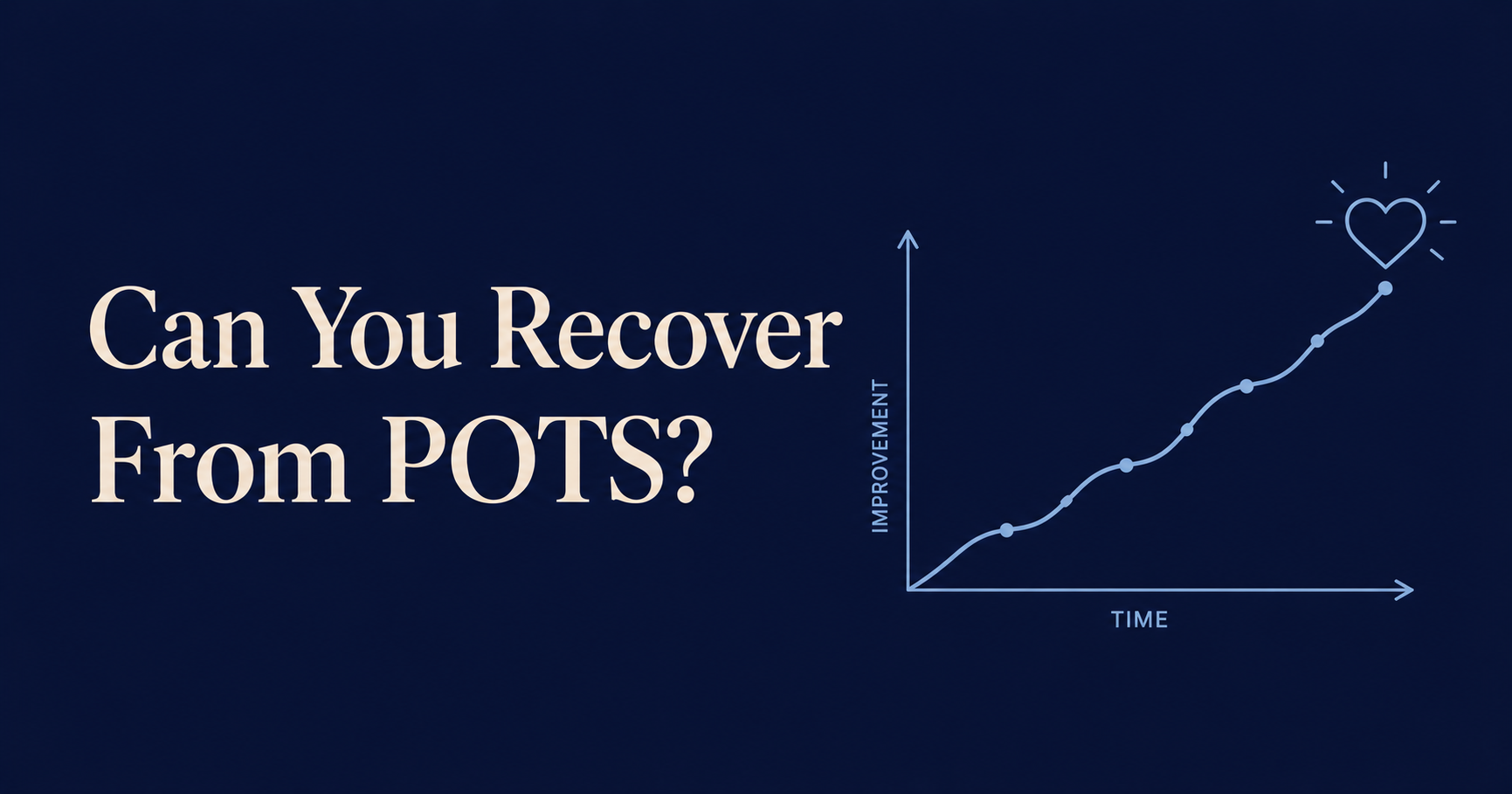
What I can tell you from my own experience is that improvement tends to come in layers. First the worst peaks of symptoms start to reduce. Then your baseline starts to lift. Then you notice you can do things you could not do before without crashing. Then one day you realise that POTS is no longer the first thing you think about when you wake up. It is a process that unfolds gradually, which makes it hard to see while you are in it.
What gives me the most hope
The thing that gives me the most hope is the mechanism itself. Your cardiovascular system is adaptable. Your autonomic nervous system is adaptable. They respond to training. They respond to consistency. They respond to being challenged in the right way at the right level.
You are not broken in a way that cannot change. You are deconditioned in a way that can improve. Those are very different things.
Recovery is not guaranteed and I will not pretend otherwise. But it is possible in a way that the medical system often fails to communicate. And for many people it is more achievable than they have been led to believe.